How to use HyperTools
Plot
- Plotting
- Import Hypertools and other libraries for tutorial
- Load your data
- Plot with default settings
- Plot in 2D
- Using other dimensionality reduction algorithms
- Coloring by hue
- Interpolating missing data
- Labeling plotted points
- Data Clustering
- Normalization
- Aligning datasets with different coordinate systems
- Saving
- Plotting text using semantic models
Analyze
Normalize
Reduce
Align
Cluster
Plotting text
Visualizing Hugging Face embeddings
Modern scikit-learn models and dynamics
Mapping Wikipedia with modern text embeddings
Visualizing the shape of a conversation
Plotting streaming data
Streaming from a Lab Streaming Layer (LSL) device
Forecasting stock prices with hyp.predict
Imputing and forecasting a real projectile arc with hyp.impute and hyp.predict
Story trajectories: brain activity while listening to a story
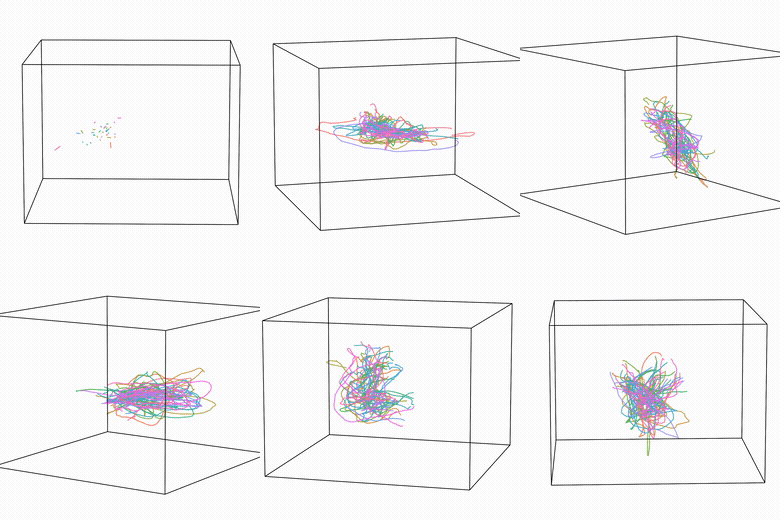
An animated cloud of hyperaligned trajectories showing how all 36 subjects’
whole-brain activity traces out a shared path through a low-dimensional space
while they listen to the same spoken story (fMRI data from Simony et al.,
2016). Each subject is preprocessed with a per-subject manip (Smooth →
Resample → ZScore), hyperaligned in the 100-hub feature space (n_iter=10)
and only then reduced to 3-D with reduce='IncrementalPCA'; an
animate='window' trail then slides along the aligned trajectories so you
watch all 36 subjects move together through the story. Aligning in the hub
space before reducing (rather than over-reducing first, which starves
hyperalignment) is what pulls the trajectories together – their within-timepoint
spread tightens ~30%. See the full gallery example,
Story trajectories: brain activity while listening to a story.