Note
Go to the end to download the full example code.
Story trajectories: brain activity while listening to a story
 run this example as a notebook — or grab the .ipynb (also linked at the bottom of the page)
This example walks through the “story trajectories” demo (GH #275): an animated cloud of hyperaligned trajectories showing how all 36 subjects’ whole-brain activity traces out a shared path through a low-dimensional space while they listen to the same spoken story.
Background
The data (hyp.load('weights')) come from Simony et al. (2016,
Nature Communications, 10.1038/ncomms12141), an fMRI study in which 36 subjects
listened to the same ~7-minute spoken story – “PieMan”, told live by Jim
O’Grady at a Moth GrandSLAM event – while their whole-brain activity was
recorded. Each subject’s raw voxel-by-timepoint data were summarized with
Hierarchical Topographic Factor Analysis (HTFA) into k=100 latent
“hubs” – spatially compact, story-timescale sources of correlated
activity – giving every subject a (timepoints, 100) trajectory through
“hub space” that HyperTools can align, reduce, and animate directly.
What the animation shows
Every subject starts the story with an idiosyncratic, unaligned activity
pattern. Hyperalignment rotates every subject’s trajectory into a common
space that maximizes shared, story-locked structure, so that, once aligned,
subjects’ trajectories move together through the space as a single coherent
cloud as the story unfolds. The animate='window' style slides a short
opaque trail along each aligned trajectory, so you literally watch all 36
subjects travel the shared path in lock-step.
A scale-free within-timepoint dispersion (the mean distance of the 36 subjects to their shared centroid at each timepoint, averaged over timepoints and divided by the overall cloud scale; lower = move together more) drops from ~0.71 to ~0.52 once the subjects are hyperaligned the RIGHT way – see below.
Getting alignment right
The critical choice is where to hyperalign:
Align in the 100-hub feature space, THEN reduce to 3-D – not the other way around. Hyperalignment needs room: it rotates each subject’s trajectory (an orthogonal transform) to match a shared response, and with only 3 (or even 10) dimensions to work in it can barely align anything, leaving the subjects a poorly-aligned tangle. Aligning in the full 100-hub space and reducing to 3-D afterwards is what pulls the displayed trajectories together (dispersion ~0.88 unaligned, ~0.84 when reduced to 3-D then aligned, ~0.71 when reduced to 10-D then aligned -> ~0.52 when aligned in hub space then reduced). Note the hub space is the “low-dimensional” space to align in – it is already a 100-dim summary of hundreds of thousands of voxels; the mistake is over-reducing further before aligning.
Use a linear reduction (IncrementalPCA).
reduce='UMAP'warped each subject’s trajectory nonlinearly and left the animation jumpy; a linear reduction keeps the aligned trajectories smooth.
The exact code
The full pipeline runs in well under a minute on the full dataset (roughly ten seconds on a modern laptop, including saving the movie), but this example does not re-run it live; it displays the pre-rendered result so the gallery stays fast and deterministic. Here is the exact code that produced it:
import seaborn as sns
import hypertools as hyp

data = hyp.load('weights')   # 36 subjects, each (timepoints, 100 hubs)

# per-subject preprocessing in native (100-hub) space. NOTE: Smooth
# requires an ODD kernel width (even widths are bumped up by 1 with a
# warning), so 41 is used here
manip_spec = [
    {'model': 'Smooth', 'kwargs': {'kernel_width': 41}},
    {'model': 'Resample', 'kwargs': {'n_samples': 300}},
    'ZScore',
]
manip_data = hyp.manip(data, model=manip_spec)

# ALIGN in the 100-hub space (n_iter=10), THEN reduce to 3-D -- reducing
# before aligning would starve hyperalignment and leave a tangle
aligned = hyp.align(manip_data,
                    align={'model': 'HyperAlign', 'kwargs': {'n_iter': 10}})

# one bold color per subject from seaborn's 'husl' palette (the classic
# HyperTools palette: evenly-spaced but tempered hues). A short sliding
# 'window' trail (focused=1.5 s) lets you watch all 36 subjects move
# together through the story. The lines are near-opaque and bold -- because
# the subjects are tightly aligned the overlapping ribbons read as ONE
# coherent shape, so opaque lines stay legible (translucent ones just blur
# into haze).
n = len(aligned)
colors = [(*c, 0.85) for c in sns.color_palette('husl', n)]
hyp.plot(aligned, '-', color=colors, linewidth=1.6, reduce='IncrementalPCA',
         ndims=3, animate='window', focused=1.5, zoom=1.5, duration=9,
         save_path='story_trajectories.mp4')
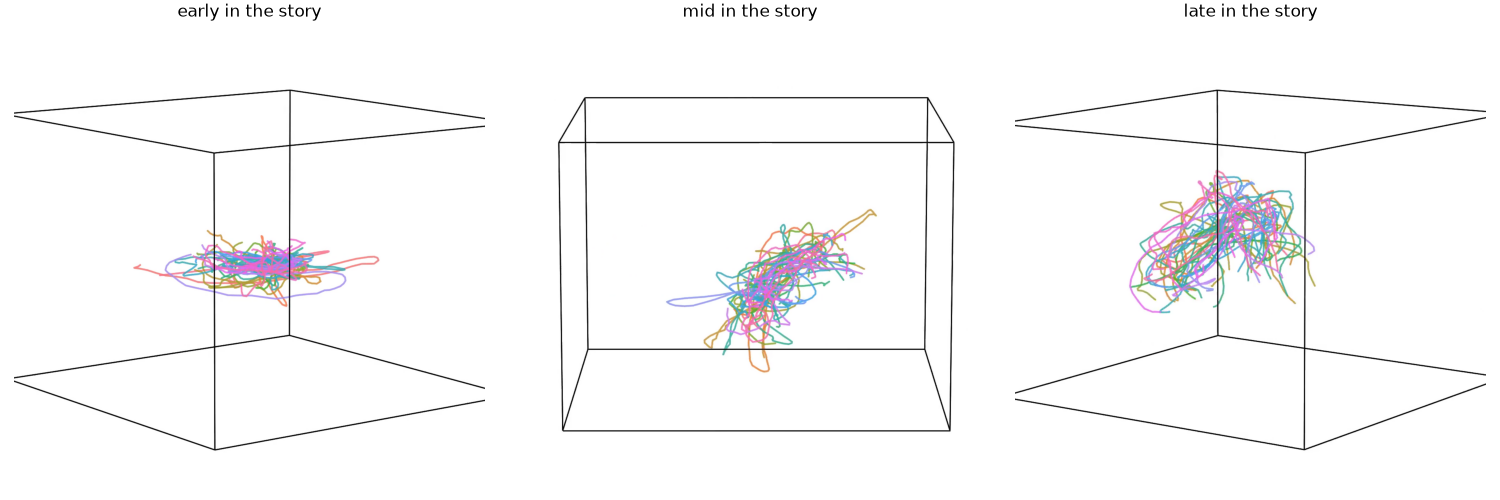
Below: three moments as the story unfolds (the window sliding from the start
to the end), followed by the full animation
(docs/images/v1.0-round17/story_trajectories.mp4).
# Code source: Contextual Dynamics Laboratory
# License: MIT

# use the pre-rendered story animation as this example's gallery thumbnail,
# matching the other animated examples (animate_spin, chemtrails, ...).
# sphinx_gallery_thumbnail_path = '_static/thumbnails/sphx_glr_plot_story_trajectories_thumb.gif'

import os

import matplotlib.image as mpimg
import matplotlib.pyplot as plt

import hypertools as hyp


def _find_img_dir():
    """Locate docs/images/v1.0-round17 regardless of how this script is
    run: directly (`__file__` is defined), or execed by sphinx-gallery
    (which chdir's into this script's own directory before running it, but
    does NOT define `__file__` -- so `os.getcwd()` stands in for it)."""
    bases = []
    try:
        bases.append(os.path.dirname(os.path.abspath(__file__)))
    except NameError:
        pass
    bases.append(os.getcwd())
    bases.append(os.path.dirname(os.path.abspath(hyp.__file__)))
    for base in bases:
        for up in ('..', os.path.join('..', '..')):
            candidate = os.path.normpath(
                os.path.join(base, up, 'docs', 'images', 'v1.0-round17'))
            if os.path.isdir(candidate):
                return candidate
    raise RuntimeError('could not locate docs/images/v1.0-round17')


IMG_DIR = _find_img_dir()

# three moments as the story unfolds -- the sliding window early, midway, and
# late -- from the pre-rendered animation. (constrained layout keeps the
# subplot titles from being clipped at the top of the figure.)
fig, axes = plt.subplots(1, 3, figsize=(15, 5), layout='constrained')
for ax, label in zip(axes, ('early', 'mid', 'late')):
    img = mpimg.imread(os.path.join(IMG_DIR, f'story_frame_{label}.png'))
    ax.imshow(img)
    ax.set_title(f'{label} in the story')
    ax.axis('off')
Total running time of the script: (0 minutes 0.658 seconds)