Note
Go to the end to download the full example code.
Applying models with apply_model
 run this example as a notebook — or grab the .ipynb (also linked at the bottom of the page)
hyp.apply_model is hypertools 1.0’s unified model-application core: datasets are stacked, the model is fit ONCE across all of them, and the result is unstacked back to the input’s structure – which is what makes embeddings and cluster assignments comparable across datasets. Models can be specified by name, as a dict with parameters, as a scikit-learn style instance, or as a list (pipeline). return_model=True hands back the fitted model for reuse on held-out data.
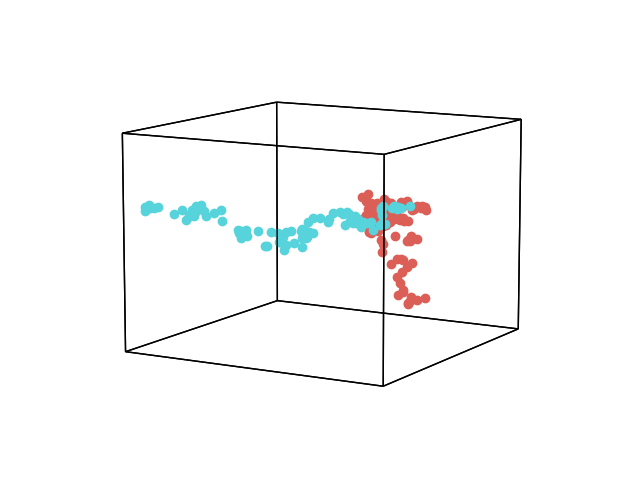
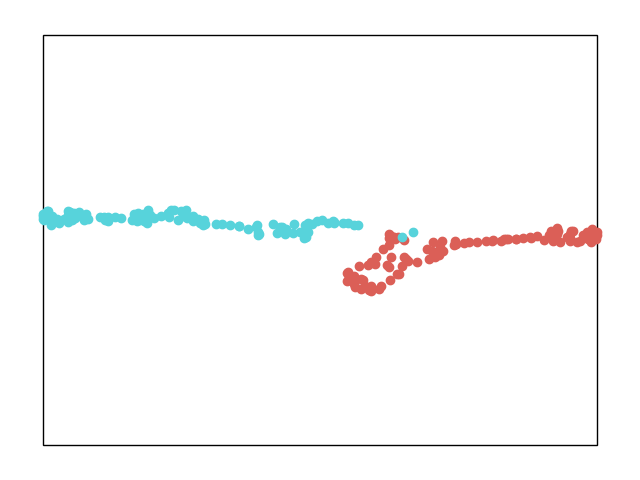
/home/docs/checkouts/readthedocs.org/user_builds/hypertools/checkouts/latest/hypertools/plot/backend.py:1353: UserWarning: Failed to switch to any interactive backend (TkAgg, QtAgg, Qt5Agg, Qt4Agg, GTK4Agg, GTK3Agg, WXAgg). Falling back to 'Agg'.
  warnings.warn(BACKEND_WARNING)
/home/docs/checkouts/readthedocs.org/user_builds/hypertools/checkouts/latest/hypertools/plot/backend.py:1353: UserWarning: Failed to switch to any interactive backend (TkAgg, QtAgg, Qt5Agg, Qt4Agg, GTK4Agg, GTK3Agg, WXAgg). Falling back to 'Agg'.
  warnings.warn(BACKEND_WARNING)
(100, 3)
# Code source: Contextual Dynamics Lab
# License: MIT

import numpy as np
import hypertools as hyp

rng = np.random.default_rng(42)
data1 = np.cumsum(rng.standard_normal((100, 10)), axis=0)
data2 = np.cumsum(rng.standard_normal((100, 10)), axis=0)

# one PCA fit across both datasets -> shared, comparable embedding
embedded = hyp.apply_model([data1, data2], 'PCA', ndims=3)
hyp.plot(embedded, 'o')

# pipelines: PCA to denoise, then TSNE to embed
embedded = hyp.apply_model([data1, data2],
                           [{'model': 'PCA', 'kwargs': {'n_components': 5}},
                            {'model': 'TSNE', 'kwargs': {'n_components': 2}}])
hyp.plot(embedded, 'o')

# reuse a fitted model on held-out data
train, fitted = hyp.apply_model(data1, 'PCA', ndims=3, return_model=True)
held_out = fitted.transform(data2)
print(held_out.shape)
Total running time of the script: (0 minutes 0.655 seconds)