Note
Go to the end to download the full example code.
Discovering clusters using HDBSCAN
 run this example as a notebook — or grab the .ipynb (also linked at the bottom of the page)
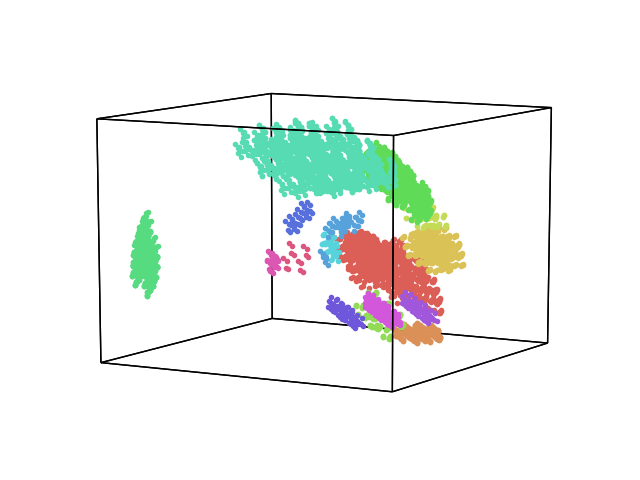
To make use of HDBSCAN as the clustering algorithm used to discover clusters, you must specify it as the cluster argument. If you wish to specify HDBSCAN parameters you will need the dictionary form, which includes both the model name and its keyword arguments (under the ‘kwargs’ key). Since HDBSCAN does not require the number of clusters, n_clusters does not need to be set. Note that HDBSCAN can also label some observations as noise (label -1); those points are colored as their own group. Because the rows of the mushrooms dataset are unordered samples, we plot them as points (‘.’).
/home/docs/checkouts/readthedocs.org/user_builds/hypertools/checkouts/latest/hypertools/plot/backend.py:1353: UserWarning: Failed to switch to any interactive backend (TkAgg, QtAgg, Qt5Agg, Qt4Agg, GTK4Agg, GTK3Agg, WXAgg). Falling back to 'Agg'.
  warnings.warn(BACKEND_WARNING)
Total running time of the script: (0 minutes 0.540 seconds)